
The Platonic Virtues
A Broad Introduction

What is Virtue?
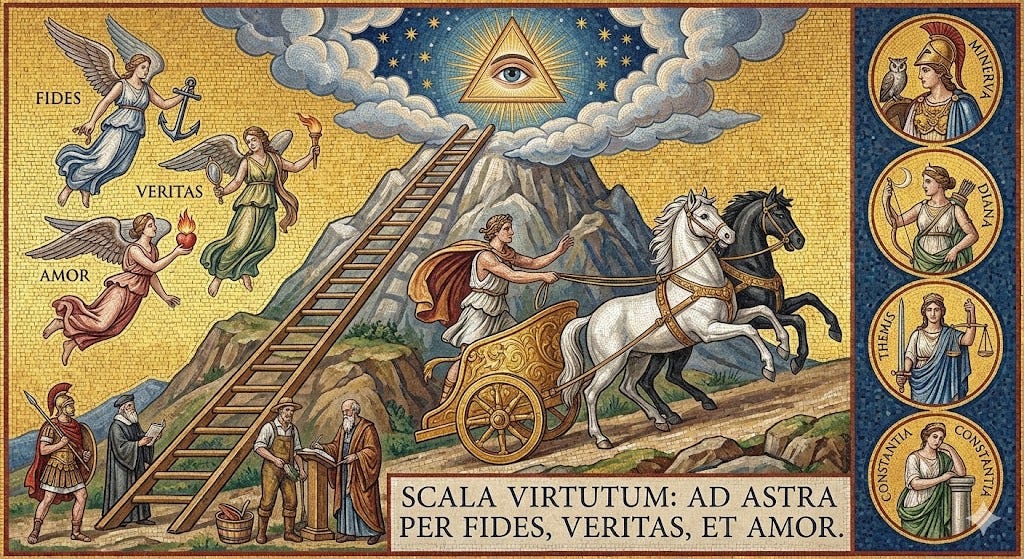
In our service on the Kalends of February, we had read the Platonic myth of the Chariot of the Soul as revealed by The Divine Plato in the Phaedrus (246a–254e). In this myth human souls were described as having three parts, a Charioteer, a black (Rebellious) horse, and a white (Noble) horse.
The Charioteer (Reason/Logos): The sovereign element, tasked with steering the soul toward the “Plain of Truth.”
The White Horse (Spirit/Thumos): The seat of our higher emotions, courage, and moral indignation. It is the natural ally of Reason.
The Black Horse (Appetite/Epithumia): The representative of our dense bodily cravings and irrational impulses. Left unchecked, it pulls the chariot toward the earth.
Virtue is the art of the Charioteer. It is the cultivated excellence that allows him to master the reins, harmonizing the horses so that the vehicle does not veer into the abyss of passion, but instead ascends to follow the train of the Gods. These virtues are not sporadic acts of “being good,” but habitual dispositions—the building blocks of a character that performs its function with the ease of a master musician.
At its foundation, virtue is the perfect arrangement of the soul. Just as a lyre must be tuned to produce music, the soul must be tuned to produce a good life. The Divine Plato teaches in the Republic (443d-e) that the just man “puts himself in order, is his own friend, and harmonizes the three parts of himself (Reason, Spirit, and Appetite) like three limiting notes in a musical scale”. 1
When the soul is discordant—when the Black Horse tramples the Charioteer, or the Spirit becomes a tyrant over Wisdom—we suffer the sickness of Vice. But when the parts agree and function according to their natural rank, we achieve the state of Virtue: a soul in perfect health, beauty, and well-being. The ultimate aim of this mastery is the “Reversion.” We steer correctly so that we may once again behold the Forms in the supracelestial place ( _Phaedrus_ 247c).
Why practice the Virtues?
As The Divine Plato teaches in the Republic (427e), these four virtues are the necessary and sufficient conditions for a city—and a soul—to be considered perfect. This perfection is the highest aim of our existence, for the destiny of our soul is inextricably linked to the cultivation of these excellences.
Why do we pursue virtue? We do not seek it for the sake of reputation, nor for the hollow rewards of the material world, which The Divine Plato dismisses as “shadow-drawings” (Phaedo 69b). Instead, we pursue virtue because it is the fundamental requirement for the soul’s survival and return.
It is a Flowering: Virtue is sufficient for eudaimonia. In the Platonic view, a soul in harmony is inherently fulfilled, even amidst external misfortune. Conversely, the tyrant who possesses all worldly power but a corrupted soul remains the most wretched of prisoners (Republic 579e).
It is Flight: Virtue is the “flight of the alone to the Alone.” It is the process of becoming “like God as far as is possible for man” (Theaetetus 176b). By practicing virtue, we shake off the “mud” of material generation and prepare the soul to return to its “kindred star” (Timaeus 42b). 2
It is Freedom: he un-virtuous man is a slave to a thousand masters—his anger, his lusts, and his fears. Only the virtuous man is truly free, for he obeys the sovereign authority of Reason and the Divine Law, rather than the fickle tyranny of his own passions.
Virtue, in short, is the process of “polishing the statue” of your own soul. As Plotinus reminds us in the Enneads (I.6.9), you must never cease working on your statue until “the divine resplendence of virtue shines forth upon your sight, and you see Temperance established in her holy pedestal.”
What are the Virtues?
Traditionally there are four virtues Wisdom, Temperance, Courage, and Justice. Each one provides purification to the soul and brings one closer to the divine. By living by these virtues we encourage ourselves to act justly, wisely, with courage, and self-control. By embodying these excellences, we align our character with the Goddesses who patronize them:
Wisdom (Minerva): The Goddess of Wisdom and the “Sheathless Sword” of the Intellect. She provides the light by which we discern the Real from the Illusion.
Temperance (Diana): The Goddess of Purity and Natural Order. She guards the soul’s boundaries, ensuring the lower impulses do not overflow their proper vessels.
Justice (Themis): The Goddess of Primordial Divine Law. She represents the cosmic balance that we must replicate within our own spirits.
Courage (Constantia): The Goddess of the Enduring Will. She provides the “adamantine” strength required to remain fixed upon the Good despite the trials of life.
Although we list them separately, The Divine Plato often speaks of virtue as a single unity. You cannot truly have one without the seeds of the others.
The Order of the Virtues
The sequence of these virtues is of critical importance. As The Divine Plato teaches in the Laws (631c-631d), the virtues are “Divine Goods,” and “if a city (or soul) receives the greater, it also acquires the lesser, but if it receives not the greater, it is deprived of both.”3
The Horizontal Order
In the Laws, the virtues are ranked by their proximity to the Divine Mind:
Wisdom: The “Leader” of all goods. It resides in the rational part of the soul. Without Wisdom, all other virtues are merely “shadow-drawings” (Phaedo 69b), hollow imitations practiced for the sake of reputation.
Temperance (Sound-mindedness): This takes the second rank. It is the agreement of the soul to be ruled by reason. It is The “Sound-mindedness” that allows a one to be his/her own master.
Justice: This arises from the combination of Wisdom, Sound-mindedness, and Courage. It is the “perfection” and “all-pervading” virtue that contains the others.
Courage: Ranked fourth because, while noble, it can exist in a distorted form even in beasts or the unjust. Only when it is informed by Wisdom does it become a Divine Good.
The Divine Plato teaches that “the human look to the divine, and the divine all look together to their leader, reason”. If you prioritize Courage over Wisdom, you become a tyrant or a brute; if you prioritize Wealth (a human good) over Justice (a divine good), you lose your soul.
The Structural Order (Beginning, Middle, End)
Hierocles of Alexandria, in his Commentary on the Golden Verses of Pythagoras (XXVI), offers a different perspective based on the Process of Growth:
The Beginning: Wisdom. Hierocles calls Wisdom the “Mother and Nurse” of the other virtues. It is the faculty that must first “settle the case” of what is right before any action can be taken.
The Middle: Courage and Temperance. These are the “Adamantine Guards” of the soul. Courage prevents the soul from being dragged down by pain; Temperance prevents it from being lured away by pleasure. Together, they protect the Charioteer (Reason).
The End: Justice. Justice is the “End of the Virtues,” the crowning achievement. It is the state of total health that exists only when the other three have done their work.
This order also makes sense, as you cannot have Justice (the whole) without the parts. Hierocles teaches that “practical wisdom is found to be the beginning of the virtues, justice the end, and in between come courage and self-control”
The Ladder of the Virtues
While later commentators—such as the Divine Iamblichus—suggested as many as seven granular levels, the American Romanist tradition prioritizes a four-tier system for its clarity and practical application in the life of the average worshiper. By focusing on rungs 2 through 5, we bridge the gap between the well-raised child, the productive citizen, the purified aspirant, and the contemplative sage.
Below, we list the full spectrum of the ascent for your clarification:
The Pre-Philosophical Virtues:
Before we can begin the philosophical life, we must possess the raw materials of character.
Natural Virtue: The innate disposition you are born with (a lion is naturally brave). This is not yet true virtue because it lacks reason.
Ethical/Habituated Virtue: Good habits formed by custom, law, and upbringing. These produce a well-behaved youth, but they are not yet “true” virtue because they are based on external training rather than internal understanding.
The Philosophical Virtues:
These are the core of our practice. They represent the soul’s active ascent.
Civic (Political) Virtue: Here, reason governs the passions to create a harmonious life with others. This makes us “good citizens” and composes the “inner city” of the soul (Republic 443d).
Purificatory (Cathartic) Virtue: Here, the goal changes. We no longer merely moderate passions; we seek to separate the soul from them entirely. Courage becomes the lack of fear of death (separation from the body); Temperance becomes the turning away from bodily pleasures to intellectual ones (Phaedo 67c).
Contemplative (Theoretic) Virtue: The soul has been cleansed and now turns its gaze solely toward true Being and the Divine Intellect. This “deifies” the soul by aligning its activity with the activity of the Gods.
The Divine (Theurgic) Virtues:
These lie “beyond philosophy” and unite the soul with the Gods.
Paradigmatic Virtue: These are the archetypes of virtue existing within the Divine Intellect itself.
Theurgic (Hieratic) Virtue: The absolute summit, where the soul transcends even the intellect to unite with the One through the ineffable power and “tokens” (Synthemata) of the Gods.
Creation of the Ladder
The ladder of virtue was not constructed by a single hand, but by a succession of Sages within the Golden Chain. Below we list those most impactful to what we express in this post and the works in which they speak on these virtues.
Porphyry of Tyre: Sententiae
Porphyry, the eminent student of Plotinus, was the first to systematically codify the virtues into the levels we use today. In his Sententiae (Section 32), he distinguishes between the Civic, Purificatory, Theoretical, and Paradigmatic virtues. This remains the primary text for our specific classification.
Plotinus: The Enneads (I.2: “On Virtue”)
Plotinus provides the metaphysical foundation for the ascent of the soul. He explains that virtues are not merely social rules, but the means by which the soul uncurls itself from matter.
“The soul is degraded by being mixed with the body... the virtue of the soul is its purification” (Ennead I.2.3).
The Divine Plato: Phaedo and The Republic
While the later masters categorized them, the seeds were sown by The Divine Plato.
Civic Level: The Republic, Book IV (427e–434d), he defines the virtues as the harmonious arrangement of the tripartite soul.
Purificatory Level: Phaedo (67c–69d), he reveals that “true” virtue is a “purgation” of the senses, a preparation for the soul’s eventual liberation.
Proclus: Commentary on the Republic
Proclus ensures our virtues are tied to the Divine Hierarchy. He clarifies how the virtues manifest under the governance of the Gods, transforming psychological states into cosmic alignments.
Macrobius: Commentary on the Dream of Scipio (Book I, Chapter 8)
For the Romanist, Macrobius is the vital bridge. He translated the Greek Platonic rigor into the Latin spirit, ensuring that the Mos Maiorum (ancestral custom) was understood as a reflection of the Divine Order. He explicitly states that “virtues are the work of the soul when it is being purified, or is already purified” (In Somnium Scipionis 1.8.5). 4
The Rungs in Depth
The virtues are the same in name—Wisdom, Temperance, Courage, and Justice—but they differ in their object and their power as the soul ascends. As expressed above, we prioritize the below four levels of virtue for the average worshiper. To be clear, all levels of virtue are important for their own reasons, but these four are the most foundational if one is committed to seeking “likeness to the Gods” (Theaetetus 176b).
I. The Habituated Virtues (Ethical Virtues)
These are the excellences formed not by philosophy or scientific knowledge, but by custom (ethos), repetition, and right upbringing (paideia). They are “pre-philosophical” virtues that belong to the soul that has been tamed by training rather than reason. This is the level of the “popular and social virtue” described in the Phaedo (82a-b).
Wisdom: At this level, it is not true “science”, but “Right Opinion” (Ortha Doxa). It is the ability to remember what is appropriate and act correctly in daily affairs based on experience and memory, without understanding the cause. It is the “good advice” or sound judgment derived from following the laws and customs of one’s elders.
Temperance: The training of the irrational soul to submit to rule through “habituation and a shaping process that is in a way bodily”. It is the taming of the appetites and the “many-headed beast” through rewards, punishments, and repetitive training, much like one trains a noble animal to be docile.
Courage: A steadiness of spirit formed by a rigorous upbringing. It is the endurance of pain and labor achieved through custom, rather than through the knowledge of what is truly to be feared.
Justice: The observance of laws, customs, and contracts out of habit or fear of shame. It is the performance of correct actions towards others and the gods—truth-telling and piety—because one has been molded by the “common concepts” and the “laws of the city” to regard these things as noble
II. The Civic Virtues
At this level, the soul is harmonized by Reason, though it remains engaged with the world. This is the level of the Republic, where we seek to be good men among men.
Wisdom: Prudence in practical affairs and the governance of the self. Wisdom is the knowledge of what is good, bad, and neither, especially regarding the community and the self.
Temperance: The agreement of the irrational parts of the soul to follow the command of reason. Temperance is specifically the harmony where the appetitive faculty does not rebel against reason.
Courage: The preservation of right opinion regarding what is to be feared and what is not (Republic 429c). More specifically, it is the preservation of right opinion about what is to be feared (dishonour/vice) and what is not (death), amidst pains and pleasures.
Justice: Each part of the soul performing its own proper function without interference. Justice is the “minding of one’s own business” within the soul, where reason rules, spirit defends, and appetite obeys.
III. The Purificatory Virtues
Here, the soul seeks to detach itself from the “leaden weights” of material generation. Here, the virtues do not merely moderate the passions; they seek to eliminate them so the soul may stand alone.
Wisdom: Contemplating reality without the use of the senses. It is the soul thinking by itself, independent of the body, not merely avoiding the senses, but generating no opinions in harmony with the body.
Temperance: A total withdrawal from the desires of the body. This is not merely moderating desires, but not sharing in the passions of the body at all.
Courage: The soul’s lack of fear in departing from the body, viewing death as a liberation, it is the refusal to be afraid of the void or non-being that the body claims death to be (Phaedo 67e).
Justice: The soul following the lead of reason and the Divine Intellect, entirely free from the contagion of matter. It is the rule of reason without opposition, where the lower soul no longer even attempts to rebel.
IV. The Contemplative Virtues
These belong to the soul that has already achieved purification and now dwells in the contemplation of the Divine Mind (the Nous). Here, the soul has turned its gaze entirely upward.
Wisdom: The direct intuition of the Forms and the First Principles of reality. It is the contemplation of the essences (beings) contained within the Intellect.
Temperance: The turning of the soul inward toward its own source. It is the intimate conversion of the soul toward the Intellect, the turning of the soul not just “inward,” but “upward” to unite with the Mind of Jove.
Courage: An unwavering stability (impassibility) in the state of contemplation. It is the state of becoming like that which is contemplated (the Intellect), which is by nature impassible.
Justice: The soul’s total adherence to its own essential nature and the Law of the Demiurge, attaching itself to the Intellect and directing its activity there alone.
Note on these levels: While we distinguish these four levels for the sake of study, the soul is a single unity. One does not abandon the Civic Virtues to reach the Purificatory; rather, the lower is subsumed into the higher, like a candle’s flame being brought into the light of the sun. As The Divine Plato intimates, the path is a gradual turning of the “eye of the soul” from the shadows to the Light (Republic 518c).
Beyond the Virtues
The Divine Wings: Faith, Truth, and Love
The Four Cardinal Virtues provide the structure of our character, but they do not move themselves. They are like a ship well-built but sitting in a windless harbor. To ascend the ladder and cross the sea of generation, the soul requires three “sun-like” powers that act as the wings of our Reversion (Epistrophe) to the One. 5
As The Divine Plato intimates, the soul is nourished by the “plain of Truth” and grows its wings through the sight of the Beautiful (Phaedrus 247c-251c).
Faith (Fides)
In the Platonic sense, Faith is not the acceptance of the unproven, but the “unshakable settlement” of the soul in the Divine. It is the deep, silent certainty that the Gods are Good and that the One is the source of all. Faith is the soul of Constantia (Courage). We remain steadfast not through our own pride or stubbornness, but because our Faith in the Divine Order makes us invulnerable to worldly fear. It is the “Anchor of the Soul.”
Truth (Veritas)
Truth is the light of the Intelligible world. It is not merely “correct information,” but a direct, unmediated contact between the Mind and the Forms. It strips away the masks of the material world and reveals the naked reality of the Good. Truth is the soul of Minerva’s Wisdom and Themis’s Justice. Wisdom is the eye, but Truth is the light that allows the eye to see. Justice is the act of ordering, but Truth is the blueprint by which we order our lives.
Love (Amor)
Love is the divine hunger for the Beautiful. It is the “Providential Heat” that melts the soul’s icy attachments to the body and pulls us upward toward our source. Love is the soul of Diana’s Temperance. We do not turn away from lower pleasures because they are “evil,” but because our Love for the Divine Beauty is so great that earthly distractions lose their luster. We choose purity because we are in love with the Light. 6
Proclus teaches that these three are inseparable. Faith provides the stability, Truth provides the illumination, and Love provides the movement. One cannot truly have one without the others. When Faith, Truth, and Love are perfected, they lead the soul to the “Threshold of the One.” Here, even these three fall away into Sacred Silence. 7
In Conclusion
The purpose of understanding this ladder is not for idle speculation, but for the transformation of your life. As The Divine Plato makes clear, the soul that fails to nourish itself on the “Plain of Truth” becomes heavy and falls back into the cycles of material distraction (Phaedrus 248c). The virtues are the tools we use to stay awake and maintain our upward trajectory.
In the American Romanist tradition, we do not view these rungs as unreachable ideals. We recognize that we honor the Gods best by imitating their excellence. When you choose to act with Constantia or judge with Themis, you are moving from a life of accident to a life of divine purpose. You are becoming a person of character who is capable of standing firm when others falter.
In our upcoming posts, we will provide a series of practical guides for each of the four virtues: Wisdom, Temperance, Courage, and Justice. We will go beyond theory to show you how to apply these principles in your daily life. We will discuss specific methods for applying Minerva’s discernment to your professional life, using Diana’s self-control to manage modern distractions, maintaining Constantia’s resolve during personal crises, and establishing Themis’s order in your family and community; just to name a few.
Go with the Gods!
Footnotes
In the Pythagorean tradition which informed The Divine Plato, the universe is held together by Harmonia. By tuning our souls, we are not just “fixing” ourselves; we are bringing our individual spirits into resonance with the Music of the Spheres.
The Divine Plato distinguishes between “human goods” (health, beauty, wealth) and “divine goods” (the virtues). The human look to the divine, but the divine look to their leader, Reason (Laws 631c).
As The Divine Plato writes in the Theaetetus (176a-b), “evil cannot find a place in the divine world, but must haunt our mortal nature.” Therefore, the ladder is our means of “flight”—not a flight away from the world’s duties, but an ascent above its corrupting influence.
Note that Macrobius was writing for a Roman elite who valued civic duty. He is the reason we prioritize the “Political” virtues as the necessary first step—you cannot be a Sage if you are not first a man of integrity within your community.
In Porphry’s Letter to Marcella (24), he lists Faith, Truth, Love, and Hope as the four pillars of the religious life.
Phaedrus (247c-251c) for the growing of the soul’s wings; Symposium (210a-212a) for the “Ladder of Love.”
Theology of Plato (Book I, Chapter 25). This is the definitive text on the Triad, where Proclus states that “all things are governed and established by Faith, Truth, and Love.”